Palm Tree Fertilizer in Florida: What to Use and When
If your Florida palm is dropping older fronds early, turning yellow in a pattern that keeps spreading, or pushing new growth that looks stunted or streaked, the usual cause is fertilizer choice, not "bad weather." Palm tree fertilizer in Florida has to answer for two things regular lawn fertilizer never has to: sandy soil that lets nutrients wash straight through the root zone, and a plant that needs far more potassium and magnesium than a lawn does. Get the formula wrong and you can watch a palm decline for years even while you're feeding it on schedule.
For more help, see our Florida Palm and Tree Identification guide.
Why Florida Palms Need a Different Fertilizer Than Your Lawn
Sandy soil doesn't hold nutrients
Most of Florida sits on sandy, low-organic-matter soil that drains fast and holds onto nutrients poorly. Rain or irrigation pushes nitrogen and potassium below the root zone before the palm can take them up, which is a big part of why deficiencies show up here more than almost anywhere else palms are grown. The fix isn't more fertilizer, it's the right release rate: UF/IFAS recommends that all of the nitrogen, potassium, and magnesium in a palm fertilizer be in slow-release (controlled-release) form, specifically so the soil doesn't get a dose it can't hold onto.
Palms need much more potassium than grass does, and turf blends don't have it
Standard lawn fertilizer is built to push green leaf growth in grass, so it's usually high in nitrogen and comparatively low in potassium. Palms are the opposite: they're heavy potassium users, and potassium deficiency in palms is generally caused by low soil potassium but gets worse with high nitrogen fertilization, because the extra nitrogen drives leaf growth the palm doesn't have the potassium to support. This isn't a minor mismatch. Palm roots spread out much farther than most people assume, and UF/IFAS notes that the roots of large palms typically extend 50 feet or more from the trunk in all directions, meaning a lawn fertilizer program anywhere in that radius, not just at the trunk, is feeding the palm too.
Micronutrients matter as much as the big three
Magnesium, manganese, and iron deficiencies are common in Florida palms specifically because of the state's sandy or high-pH soils, and each one produces a different, recognizable symptom pattern (more on that below). A fertilizer that only addresses nitrogen-phosphorus-potassium and ignores these will leave a palm chronically yellow even when it's "fed."
The Fertilizer to Actually Use
The formula UF/IFAS recommends
For the vast majority of landscape and field-grown palms in Florida, UF/IFAS recommends an 8-2-12-4 palm fertilizer (8% nitrogen, 2% phosphate, 12% potash, 4% magnesium) with micronutrients, applied at roughly 1.5 pounds of product per 100 square feet of root zone area, about every three months. This isn't a rough guideline, it's the standard maintenance recommendation used by Florida arborists and extension agents. If a bag doesn't show something close to that 8-2-12-4 ratio with magnesium and micronutrients included, it isn't a palm fertilizer no matter what the front label says.
- Look for an analysis close to 8-2-12-4 with added Mg on the guaranteed-analysis panel, not just the words "palm" or "tropical" on the front of the bag.
- Confirm the nitrogen, potassium, and magnesium are listed as slow-release, controlled-release, or coated (sulfur-coated urea, polymer-coated potassium sulfate, and similar) rather than a fast-release source.
- Check that manganese and iron are included, since Florida soils commonly run short on both.
Granular beats spikes and liquid for established palms
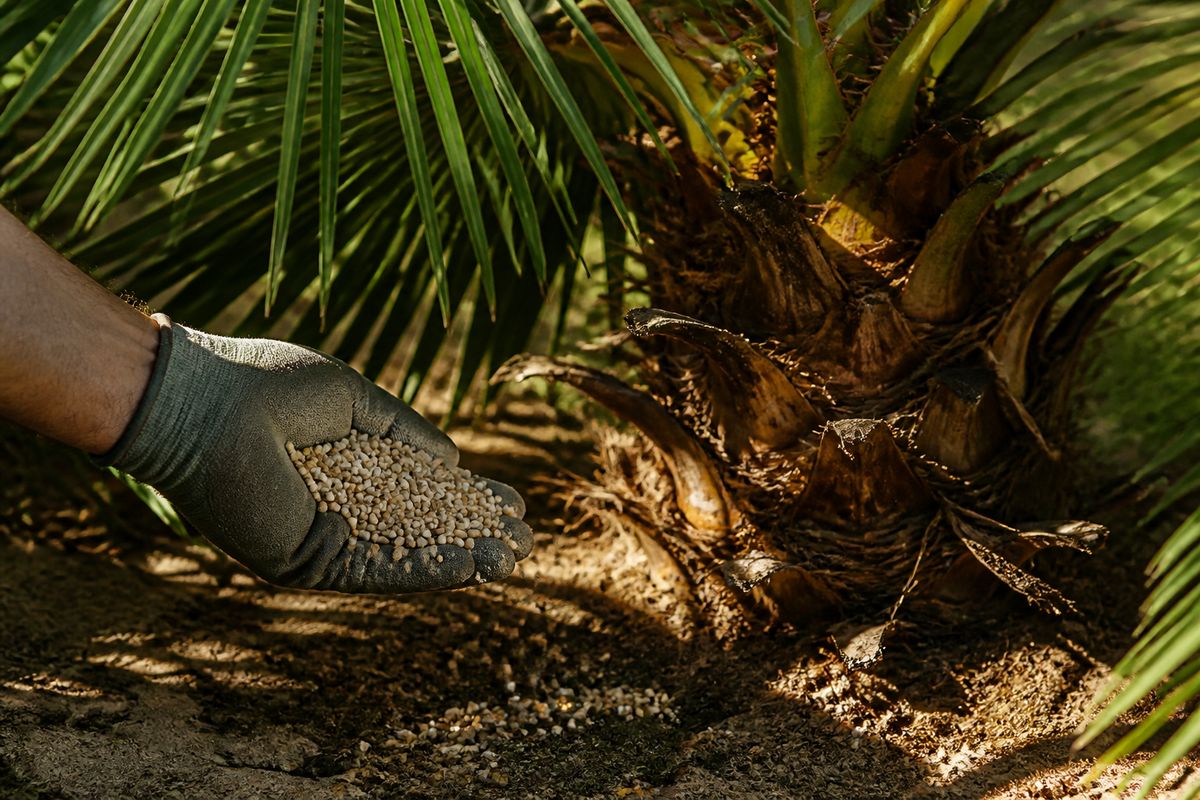
Granular slow-release fertilizer, broadcast over the full root zone, is what UF/IFAS bases its rate recommendations on, and it's the most forgiving format for a homeowner to apply evenly. Fertilizer spikes concentrate nutrients in a few narrow columns instead of across the root zone a mature palm actually uses, so large palms end up underfed near the trunk and untouched everywhere else the roots reach. Liquid feeds can work for container palms or a quick correction, but on an established in-ground palm they wash through sandy soil fast and need repeat applications to match what one granular feeding delivers.
When to Fertilize, By Region
Every region of Florida works on roughly the same three-to-four-times-a-year rhythm, tied to the palm's active growing season rather than the calendar month:
- North Florida: palms slow down noticeably once nights turn cool. Time feedings from around March/April through September, and skip the December-February window when the palm isn't pulling much up anyway.
- Central Florida: a somewhat longer active season, with feedings from around February/March through October working well.
- South Florida: palms keep growing nearly year-round, so a steady quarterly schedule holds up even in winter, as long as the palm isn't stressed by an unusual cold snap or drought at the time.
In all three regions, the practical schedule is the same: feed every 8 to 12 weeks (three to four times a year) at the labeled rate, and skip a round rather than double up if the palm is stressed, recently transplanted, or sitting in soggy soil.
How to Fertilize the Right Way
Feed the root zone, not the trunk
The single most common mistake is treating a palm like a shrub and dumping fertilizer in a ring near the base. Palm roots grow outward, not just down and out from directly under the trunk, so the effective feeding area is the ground under the entire canopy spread and somewhat beyond it. For a young palm with a 6-foot canopy, that's already a wider circle than most people fertilize; for a mature palm, remember that 50-foot root spread UF/IFAS documents, and understand that fertilizer applied to your lawn is already reaching it.
- Broadcast fertilizer evenly from just past the trunk out to the drip line and slightly beyond, not in a tight ring at the base.
- Keep granules off the trunk and out of the crown (the bud at the top where new fronds emerge); direct contact there can scorch tissue.
- Water in thoroughly after spreading so granules dissolve into the root zone instead of sitting on dry sand.
Water in, but don't drown it
After fertilizing, irrigate enough to move nutrients into the top 12-18 inches of soil where most active roots are. In sandy soil that usually means a longer, slower watering rather than a quick sprinkle, since a fast burst runs off before it soaks in. Follow that with your normal watering schedule. Don't keep the area saturated for days afterward; waterlogged sand pushes oxygen out of the root zone and can stress roots almost as much as drought does.
Deficiency Symptoms, and What They Actually Mean
Reading which fronds are affected tells you which nutrient is short, because different deficiencies show up on different leaf ages, per UF/IFAS's palm nutrient-deficiency reference:
- Potassium (K): shows up on the oldest fronds first, as yellow-orange spotting or leaflet tip and margin dieback. It's the most common and most damaging deficiency in Florida landscape palms, and, as noted above, it's made worse by high-nitrogen fertilizer, which is exactly what a palm gets when it's fed lawn fertilizer.
- Magnesium (Mg): also shows up on older fronds, but as broad yellow bands along the leaf margins while the center of the leaflet stays green, a different look from potassium's spotting.
- Manganese (Mn): the opposite pattern, it shows up on the newest emerging fronds, which come out weak, yellow-streaked, and undersized, sometimes with a scorched or curled look in severe cases (extension agents call this frizzletop). This one signals a more urgent problem because it hits the palm's new growth directly.
A soil or tissue test is worth the cost if symptoms persist after two full feeding cycles on the right fertilizer. Don't respond to any of these by adding extra nitrogen. More nitrogen without more potassium and magnesium usually makes the imbalance worse, not better.
Newly Planted and Transplanted Palms
A palm that was just planted or dug and moved has a reduced root system that can't take up nutrients the way an established palm can, so heavy fertilizing right after transplant does more harm than good. Let the palm show clear signs of recovery first, steady spear leaf emergence and firm, upright fronds, before starting a full feeding schedule. Once it's actively rooting, start with a light application of the same slow-release palm formula rather than a specialty "transplant" product, and keep the soil around the root ball consistently moist without waterlogging it. Container-grown palms need the same patience: let them push new growth in their new spot before you start feeding on the regular quarterly schedule.
Common Mistakes
- Using lawn fertilizer as the default palm feed. It's high in nitrogen and short on potassium and magnesium, the exact combination that induces deficiency in palms.
- Fertilizing only near the trunk. It misses most of the root system on anything but a very young palm.
- Adding extra nitrogen when fronds yellow. Yellowing is almost always potassium, magnesium, or manganese, not a nitrogen shortage, and more nitrogen can worsen a potassium deficiency.
- Feeding a stressed palm on schedule anyway. Skip or delay a round if the palm is freshly transplanted, drought-stressed, or recovering from cold damage.
Frequently Asked Questions
What is the best fertilizer for palm trees in Florida?
A slow-release palm fertilizer with an analysis close to 8-2-12-4 (nitrogen-phosphate-potash-magnesium) plus micronutrients, which matches the standard UF/IFAS maintenance recommendation for Florida landscape palms.
How often should I fertilize palm trees in Florida?
About every 8 to 12 weeks, three to four times a year, timed to the palm's active growing season for your part of the state. Established palms on a slow-release formula don't need feeding more often than that.
Should I water palm trees after fertilizing?
Yes. Water thoroughly right after spreading fertilizer so it dissolves into the root zone instead of sitting on top of dry sand, then return to your normal watering schedule.
Can I use lawn fertilizer on palm trees?
No, not as a regular feeding program. It's too high in nitrogen relative to potassium and magnesium, and can bring on or worsen potassium deficiency, which is the most damaging nutrient problem palms get in Florida.
Do transplanted palm trees need fertilizer right away?
No. Wait until the palm shows clear signs of new root activity, steady spear leaf growth, before starting even a light feeding, and hold off on the full schedule until it's established.