Florida Palm and Tree Identification: Species, Clues, and Care
Florida palm and tree identification comes down to reading a handful of traits that hold steady across seasons, instead of guessing from leaf color or a quick glance. Get the trunk, frond, and crown right and you skip the wrong fertilizer, the wrong pruning cut, and the wrong panic when a plant just looks different in winter.
How to Identify Florida Palms
Palms are simpler to sort than trees once you know where to look. Work from the trunk up to the crown, then confirm growth habit last.
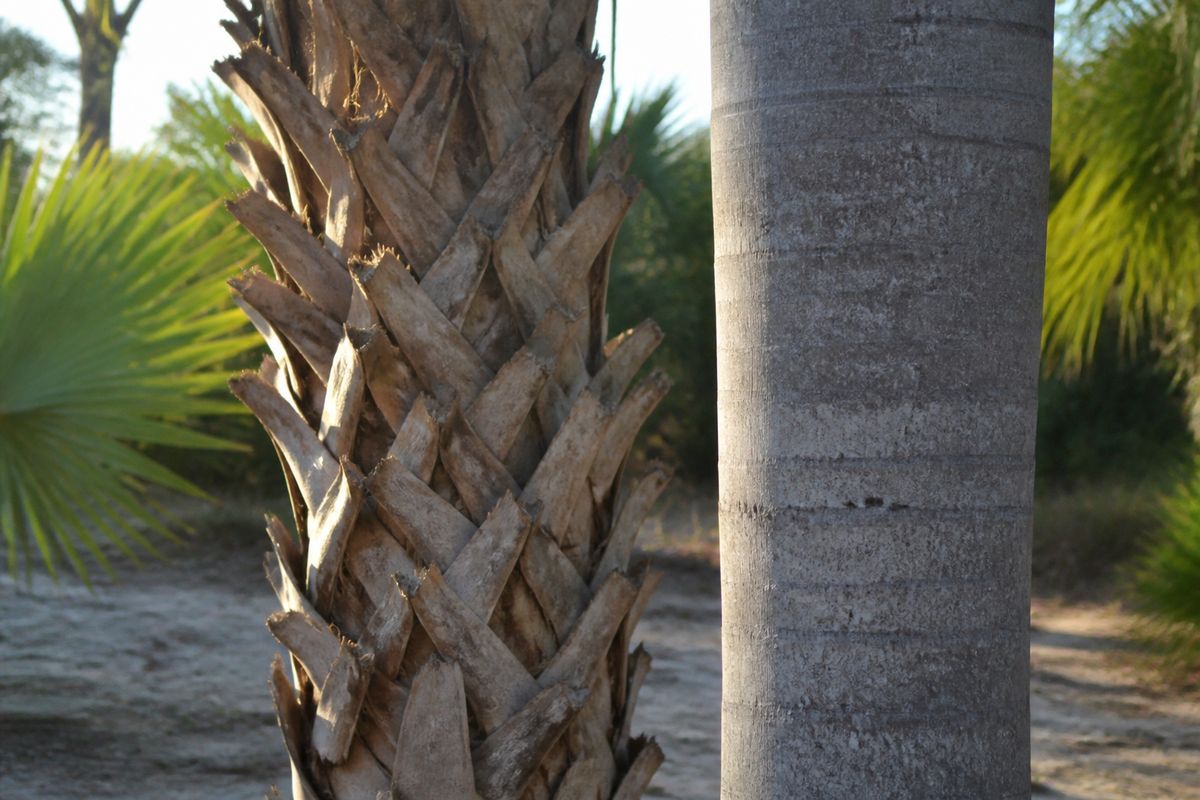
- Check the trunk. Is it smooth, ringed with old leaf-base scars, swollen at the bottom, or crosshatched with a diamond "boot" pattern left by old leaf bases? Queen palm keeps a smooth gray trunk; sabal palm (Florida's state tree) often carries a shaggy boot section before it self-cleans lower down with age.
- Identify the frond type. Fronds are either pinnate (feather-shaped, leaflets branch off a central rib, like coconut or queen palm) or palmate/costapalmate (fan-shaped, blades radiate from one point, like sabal or Washington fan palm). This one trait rules out roughly half the candidates immediately.
- Look at the crown shape. Some palms hold an open, umbrella-like head; others stay dense and full down low. Crownshaft palms, like royal palm, show a smooth green column just under the canopy; others show stacked old leaf bases right up against the fronds instead.
- Confirm solitary versus clumping. One trunk per plant usually means a solitary species. Multiple stems rising from one base means a clumping species, European fan palm and many bamboo palms grow this way, though a few solitary species get planted in tight groups of two or three and get mistaken for clumpers at a glance.
Florida's native sabal palms show how much these small details matter up close. The common landscape sabal palmetto carries a stout trunk 6 to 18 inches across with 15 to 30 fronds, while the smaller scrub palmetto and dwarf palmetto keep their stems mostly underground and carry far fewer leaves, according to University of Florida IFAS Extension. Costa shape, leaf color, and whether fiber strands hang between the leaflets are what separate these closely related species when the trunk alone isn't enough to tell them apart.
How to Identify Common Florida Trees
Trees give you more clues than palms do, but leaf arrangement and bark are still the fastest starting points.
- Read the leaf arrangement first. Opposite (two leaves per node, directly across from each other), alternate (one leaf per node, staggered), or whorled (three or more per node). This narrows the field before you even look at leaf shape.
- Study the bark. Smooth and light-colored, deeply furrowed, scaly plates, or papery and peeling all point in different directions. Crape myrtle and gumbo-limbo both shed bark in patches but look nothing alike once you compare color and texture up close.
- Find fruit, seed pods, or flowers. These are often the single most reliable clue, and they persist longer than leaves after storms or a cold snap knocks foliage down.
- Note the overall growth habit. A narrow upright form, a wide spreading canopy, or a weeping shape usually points to a specific species or cultivar.
- Factor in the site. Salt tolerance, wet feet, or dry sandy soil filter which species are realistic in a given spot. A tree thriving three blocks from the beach in Naples is a different candidate list than one in a low, wet yard in Gainesville.
Seasonal Changes That Affect Identification
Plants look different in April than they do in December, and Florida's swing between wet season, dry season, and the occasional freeze or hurricane adds even more variation. Don't mistake a seasonal look for damage, or damage for a seasonal look.
- Track what's visible by season. Flowers and fruit cluster mostly in spring and early summer; winter strips leaves off deciduous trees and exposes bark and branching structure you couldn't see in July.
- Watch for heat, drought, and storm stress. After a heat spike or a hurricane, leaves scorch, drop early, or shred, which can hide a plant's normal silhouette for weeks.
- Separate new growth from old growth. Fresh fronds and new leaf flush are often brighter green and cleaner-edged; the trunk, bark, and branch structure underneath are the parts that stay constant and are more reliable for identification.
- Lean on permanent features. Trunk pattern, branching structure, and bud or leaf-scar arrangement hold up across seasons in a way leaf color never does.
Palm Nutrition and Care After Identification
Once you actually know the species, feeding it correctly stops being a guessing game. Florida's sandy soils drain fast and hold onto potassium and magnesium poorly, which is exactly why so many landscape palms look chronically hungry.
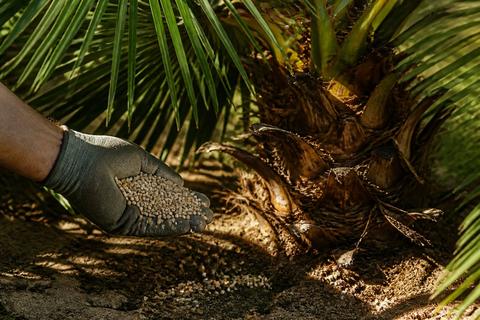
- Match the fertilizer to Florida conditions, not a generic bag. UF/IFAS recommends a slow-release palm fertilizer formulated as 8-2-12 with 4% magnesium (written 8-2-12+4Mg) as suitable for palms across the state, rather than a standard lawn fertilizer blend, according to UF/IFAS Gardening Solutions.
- Feed on a spring-through-fall schedule. Apply during the active growing season and stop for winter, since growth slows and the palm can't make use of extra nutrients anyway.
- Keep heavy turf fertilizer away from palm root zones. High-nitrogen lawn fertilizer applied near palms can trigger or worsen potassium deficiency in the palm itself, so don't feed the lawn right up to the trunk and assume the palm is covered.
- Read the fronds before you diagnose. Potassium deficiency always shows up on the oldest fronds first, though the exact look varies by species, some show translucent yellow-orange spotting, others show necrosis along the leaflet margins and tips. UF/IFAS describes it as perhaps the most widespread palm nutrient deficiency, and the leading cause of mortality in royal palms (Roystonea) in southern Florida landscapes when it goes uncorrected for years.
- Don't confuse it with magnesium deficiency. Magnesium deficiency also shows on the oldest leaves, but as a broad yellow band along the leaf margin with the center of the leaf staying distinctly green, which is a distinct pattern from the spotting or leaflet-tip necrosis potassium deficiency produces. A sharp yellow-margin-versus-green-center split points to magnesium; spotting or tip dieback on the oldest fronds points to potassium.
- Fix the site before you fix the feeding. A palm sitting in standing water or deep shade won't respond to fertilizer, because root stress is the actual problem. Correct drainage and light first.
When to Call an Arborist or Extension Service
Some IDs and some problems are not DIY jobs, especially when the plant is young, storm-damaged, or missing the features you'd normally use to identify it.
- Get a second opinion on uncertain IDs. If trunk, fronds or leaves, bark, and fruit or flowers don't add up to a confident match, your county extension office can usually identify it from photos or a sample faster than guesswork.
- Call for anything that looks diseased. Fast wilting, cankers on the trunk, fungal conks (shelf-like fruiting bodies), or dieback starting at the top of the canopy are not wait-and-see situations.
- Treat storm damage as urgent. A cracked trunk, hanging broken fronds or limbs, or a leaning palm with exposed or damaged roots can fail without warning.
- Always bring in a professional near power lines or structures. Any pruning or removal near lines, roofs, or walkways should go to a certified arborist, not a homeowner with a pole saw.
Full Guide: Palm Tree Fertilizer in Florida: What to Use and When
Frequently Asked Questions
What is the easiest way to identify a Florida palm tree?
Start with frond shape: feather-like (pinnate) or fan-like (palmate/costapalmate). Then check the trunk pattern, crown shape, and whether the palm grows as a single stem or a cluster. Those four traits together narrow most Florida landscape palms down to just a couple of candidates.
Can I identify a tree in Florida by its leaves only?
Rarely with full confidence. Leaves get you started, but bark texture, fruit or seed pods, flowers, and overall growth habit fill in what leaves alone can't, especially on a tree that's partly bare after a storm or a cold snap.
Why do some Florida palms look so similar?
Many share the same general frond shape and trunk silhouette from a distance. The separating details are close-up: where the frond attaches, how full or open the crown is, the trunk's ring or boot pattern, and whether it's solitary or clumping. Site context, coastal, inland, or planted bed, narrows it further.
Should I fertilize a palm before I know what species it is?
Identify it first. Palm species differ in how much potassium, magnesium, and micronutrients they need, and guessing with the wrong product can leave a real deficiency uncorrected. Once you know the species, a Florida-formulated palm fertilizer (like 8-2-12+4Mg) applied on a spring-through-fall schedule is the standard starting point.