How to Fertilize Fruit Trees: Type, Rate, and Timing
How to fertilize fruit trees comes down to three decisions: which fertilizer type fits your tree and soil, how much to apply for the tree's size, and when to feed so nitrogen builds fruit instead of just leaves. Get those three right and most of the yellowing, weak-flowering, and "lots of leaves, no fruit" problems in Florida yards clear up on their own.
For more help, see our How to Grow Fruit Trees in Florida guide.
Pick a fertilizer type that matches your tree and your soil
What N-P-K numbers actually do
Nitrogen (N) drives leaf and shoot growth, phosphorus (P) supports root development and flower initiation, and potassium (K) supports flowering, fruit fill, and disease resistance. Buy a fertilizer with a labeled N-P-K ratio rather than an unmarked "tree food," and for fruiting trees look for a ratio where potassium is equal to or higher than nitrogen (something like 8-3-9) rather than a lawn-style high-nitrogen blend. Heavy nitrogen with little K pushes leafy growth and can cost you flowers.
- Granular balanced fertilizer (8-8-8, 10-10-10, or a labeled citrus/fruit tree blend) is the easiest default without a soil test.
- Slow-release or controlled-release granules (coated, releasing over 6-12 months) cut down on how often you need to apply and lower burn risk.
- Organic sources (composted manure, blood meal, fish emulsion, bone meal) release more slowly and improve soil over time, but you have less control over exact timing of nutrient availability.
Why citrus, mango, and banana need a different approach
Florida's high-pH sandy and calcareous soils bind up iron and manganese so the tree can't take them up even when the soil isn't actually deficient in them. Citrus grown on Florida's alkaline soils commonly develops iron chlorosis (young leaves turn pale yellow to white with the veins staying green) and manganese chlorosis (a fine web of green veins on a lighter background), and manganese deficiency in particular tends to show up worst in spring after a cold winter.
In South Florida's higher-pH soils (roughly pH 7.8-8.8), granular micronutrients mostly stay locked up in the soil, so foliar sprays or chelated drenches work better than mixing iron into a granular blend. If you do drench, use a chelated iron formulated for high pH (Fe-EDDHA) rather than the cheaper Fe-EDTA, which breaks down and becomes unavailable above roughly pH 6.5-7.
- Citrus: use a citrus-specific blend, and treat iron/manganese chlorosis with a foliar spray or chelated soil drench rather than more granular fertilizer.
- Mango and lychee: look for a lower-nitrogen, higher-potassium ratio (an 8-3-9 style blend); heavy nitrogen delays flowering.
- Banana: banana is a heavy nitrogen and potassium feeder because of how fast it grows, so it tolerates and needs more frequent feeding than most fruit trees.
Match the rate to tree age and trunk size
Newly planted trees
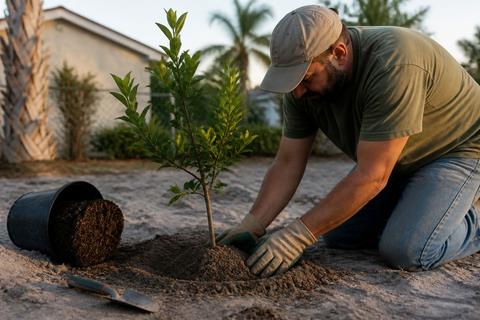
Skip fertilizer at planting. Wait until you see new leaf growth, usually a few weeks to a couple of months after planting, then start with a light, diluted dose kept well away from the trunk. Roots on a newly planted tree haven't spread yet, and a full-strength dose right against the trunk can burn them and set the tree back instead of helping it establish.
A simple rate guide by trunk diameter
Measure trunk diameter about 12 inches above the soil line, then scale your total yearly fertilizer to that number, split across 2-4 feedings during the growing season rather than dumped on all at once:
- Trunk under 1 inch: roughly 1/4 to 1/2 pound of actual fertilizer per feeding, several feedings per year.
- Trunk 1-2 inches: about 1 pound per feeding.
- Trunk 2-4 inches: about 1.5-2 pounds per feeding.
- Established mature trees (4+ inches): a common rule of thumb is roughly 2 pounds of fertilizer per inch of trunk diameter per year, split across 3-4 feedings, but always confirm against your product label.
These are starting points, not fixed law. Always check the bag's label for its own rate table, since a 10-10-10 and an 8-3-9 deliver different amounts of actual nitrogen per pound.
Why more is not better
Overfeeding does two specific things: it pushes vegetative growth at the expense of flowering, and it raises soil salt concentration around the roots, which shows up as scorched leaf margins and stunted new growth. If a tree looks thin or pale, the fix is almost never "add more fertilizer" - check soil moisture and timing first, since both nitrogen deficiency and drought stress can look similar from a distance.
Apply it the right way
Where to put it
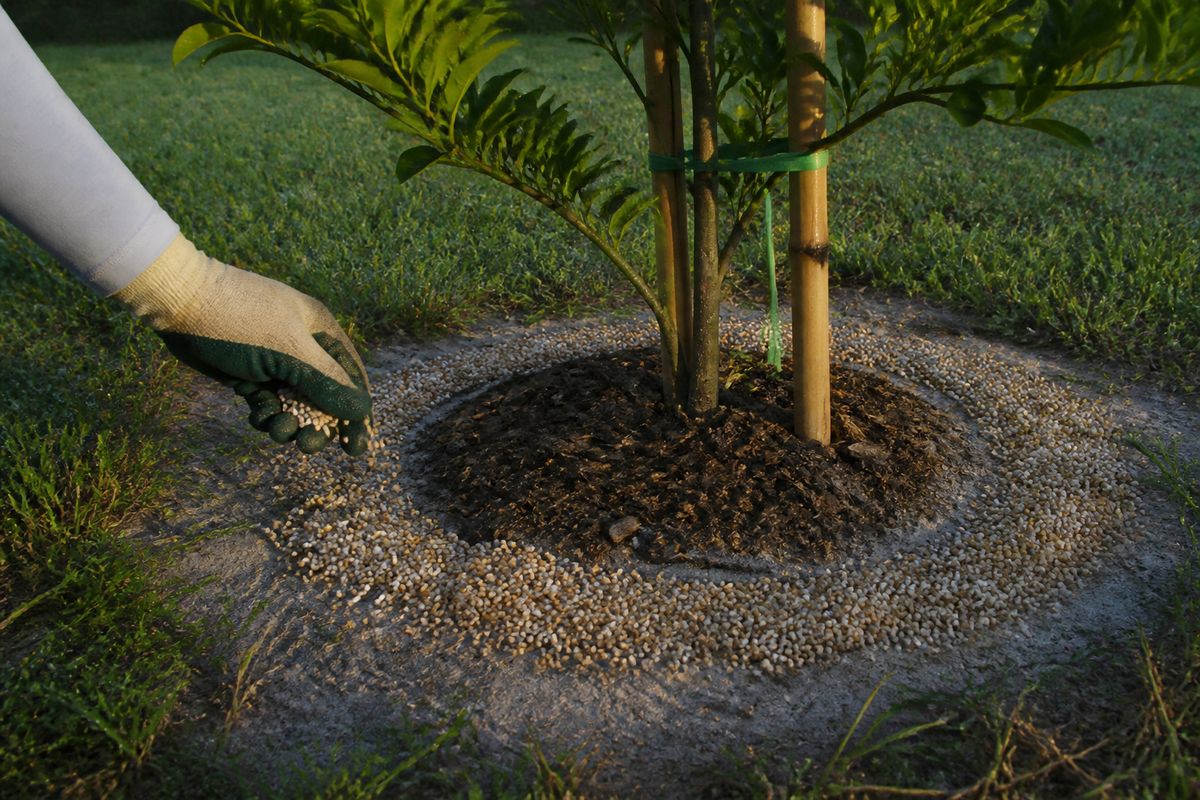
Feeder roots that actually take up fertilizer are concentrated at the dripline and beyond, not in a tight ring against the trunk. Spread granular fertilizer in a band starting several inches from the trunk out to the edge of the canopy and slightly past it. For citrus specifically, UF/IFAS Extension advises spreading fertilizer just past the dripline and beyond, widening the ring every year as the canopy grows, and always kept off the bark.
- Never pile granules against the trunk.
- Widen your application ring every year as the canopy grows.
- Water in immediately after applying granular fertilizer, soaking the top 6-8 inches of soil so the nutrients reach the root zone instead of sitting on the surface.
Time it around Florida's growing season
When to start in spring
Start feeding as new growth begins, not weeks ahead of it. Applying nitrogen or heavy irrigation before a citrus tree starts flowering can push the tree into leaf growth instead of bloom, which is the opposite of what you want on a bearing tree.
How often through the season
For established Florida citrus, a common home-orchard schedule is three to four feedings a year starting around May and continuing roughly every other month through the rainy season, since micronutrient uptake and general nutrient movement both depend on consistent soil moisture. Young trees in their first few years often do better with more frequent, smaller feedings (3-4 times between spring and early summer) rather than fewer large ones. Mature bearing trees typically need only 2-3 feedings a year, timed to the start of spring growth and again during early fruit development.
When to stop
Cut off nitrogen-heavy feeding roughly 6-8 weeks before your fruit's expected harvest window. Late nitrogen encourages soft new growth right when you want the tree focused on ripening and, in cold-sensitive species, hardening off before winter. In North and Central Florida, also stop pushing new growth heading into fall so cold-tender flushes aren't still soft when the first freeze risk arrives.
Florida's sandy soil changes the math
Florida's native sandy soils drain fast and hold onto very little of what you apply, so nutrients leach past the root zone sooner than they would in clay or loam. That's the main reason Florida fertilizing guides lean toward more frequent, smaller feedings instead of one or two large annual doses, and why working compost or mulch into the root zone helps the soil actually hold water and nutrients between applications.
Reading the tree: deficiency vs. overwatering
What deficiency symptoms look like
- Nitrogen: older leaves fade to pale green or yellow first, with generally weak new shoot growth.
- Potassium: leaf margins burn or scorch, and fruit fill and disease resistance suffer.
- Iron (common on Florida's alkaline soils): new leaves turn light yellow to nearly white while the veins stay green.
- Manganese (worse after a cold winter): a fine network of green veins over a paler leaf, on new growth.
A soil test is still the fastest way to tell a true nutrient shortage from a pH-lockout problem, since a soil can test adequate in iron and still produce a chlorotic tree if the pH is holding that iron in an unavailable form.
Don't confuse this with overwatering
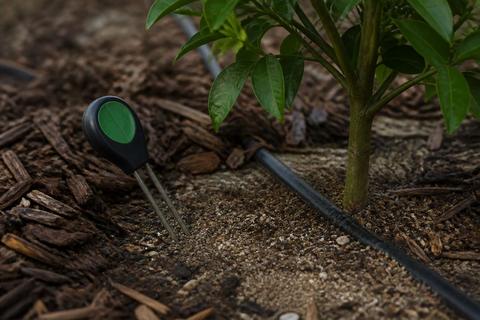
Overwatered trees usually show yellowing paired with wilting, a general dull decline, or soft/mushy surface roots, and the soil itself stays wet days after you'd expect it to drain. Check soil moisture 2-3 inches down before you fertilize; feeding a tree sitting in saturated soil wastes the application and adds salt stress on top of an already stressed root system.
Fertilizer's real relationship to fruit size and ripening
Fertilizer supports yield indirectly, through flowering, fruit set, and fruit fill, not by acting directly on fruit size. Balanced spring feeding backs flower formation and early fruit set; potassium later in the cycle backs fruit fill and quality. But nitrogen applied too close to harvest does the opposite of help; it pushes soft new growth that can delay ripening and leave fruit more prone to splitting, which is the main reason the "stop 6-8 weeks before harvest" rule exists in the first place.
Frequently Asked Questions
What is the best fertilizer for fruit trees?
There isn't one universal answer. A balanced granular fertilizer with visible N-P-K numbers is a reasonable default for most home orchards without a soil test, but citrus and other tropical fruit trees on Florida's alkaline soils usually need a lower-nitrogen, higher-potassium blend plus separate micronutrient treatment for iron and manganese.
How often should fruit trees be fertilized?
Most home orchard trees do best with 2-4 feedings during the active growing season rather than constant light applications. Young trees generally want more frequent, smaller doses; mature bearing trees usually need fewer, better-timed ones.
When should I fertilize fruit trees in spring?
Start as new growth begins, not weeks ahead of it. Fertilizing too early, while the tree is still dormant or slow, wastes product to leaching before roots are actively taking up nutrients.
Should newly planted fruit trees be fertilized right away?
No. Wait until you see clear new growth, then start with a light, diluted dose kept away from the trunk. Full-strength fertilizer on a newly planted tree's undeveloped root system is more likely to burn roots than help them.
Do citrus trees need a different fertilizer schedule?
Yes. Citrus in Florida commonly needs micronutrient management, iron and manganese in particular, that most other fruit trees don't, and on high-pH South Florida soils that usually means foliar sprays or chelated drenches rather than relying on granular fertilizer alone.
Is organic fertilizer good for fruit trees?
It can work well, especially for building soil structure over years of use. The tradeoff is slower, less precise nutrient release, so timing and consistency of application matter more than with a synthetic fertilizer.