How to Transplant a Citrus Tree
If you are moving a citrus tree because the yard layout changed, or you are trying to save one that is struggling where it stands, how to transplant a citrus tree comes down to three things: picking the right window, keeping the root ball intact, and getting the planting depth right so the tree can restart growth without rotting at the collar. Rush any one of those and you get leaf drop, sunburned bark, and a tree that sulks for a year instead of resuming growth.
For more help, see our How to Grow Fruit Trees in Florida guide.
Before You Start
Check whether the tree is a good transplant candidate
Start with the tree's health, not the calendar. Transplant citrus that is already vigorous, has green leaves, and is pushing normal new growth. Skip trees that are declining fast, carrying heavy scale or psyllid damage, or showing the blotchy yellow mottling that points to a root or vascular problem rather than a simple site issue.
- Inspect leaves and twigs for pests, sticky honeydew residue from scale or aphids, and dieback.
- Scratch a small patch of bark on a twig; healthy tissue is green underneath, not brown or dry.
- Check drainage where the tree will go. Citrus roots do not tolerate standing water for more than a day or two.
- Be honest about size. A tree you can lift with two people and a tarp is a reasonable DIY job; anything with a trunk much past 3-4 inches across is a job for a tree spade or a professional.
If the tree is already stressed from drought or a recent freeze, fix that problem first and wait for it to recover before you dig.
Pick the right season, and know Florida citrus is the exception
For most fruit trees, the safe window is a dormant-season move in winter. Citrus does not follow that rule, because a young transplant with a disturbed root system has almost no cold tolerance and a hard freeze can kill it outright. In Florida, University of Florida/IFAS Extension's citrus planting guidance points to summer through early fall, roughly July through October, as the better planting window, once the frost risk is long gone and the rainy season gives the tree steady moisture while it re-roots.
- In peninsular Florida (zones 9b-11), aim for summer into early fall rather than late winter.
- In north Florida and inland Texas (roughly zones 8b-9a), where a late frost is still possible into March, wait until the danger of frost has clearly passed before moving citrus specifically, even though other fruit trees in the same yard can go in during the December-February dormant window recommended by Texas A&M AgriLife Extension.
- Never transplant citrus into a stretch of forecast nights near or below freezing. A newly moved tree with a compromised root system can suffer serious injury at temperatures a settled, established tree would shrug off.
- Avoid moving trees during an active drought unless you can commit to heavy irrigation immediately after.
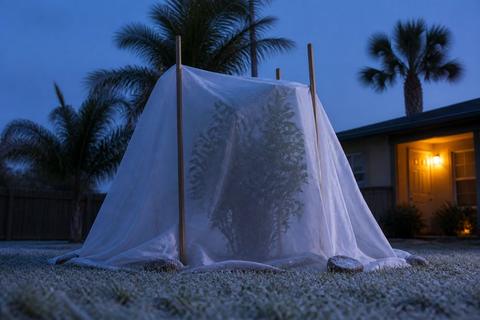
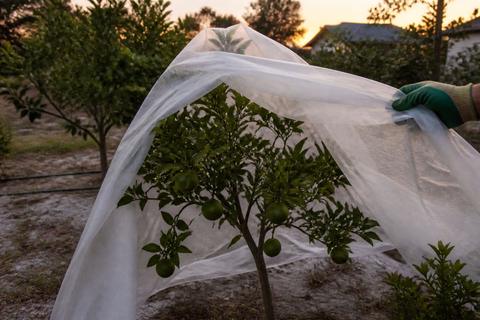
If a late cold snap catches a tree you just moved, UF/IFAS Extension recommends draping frost cloth (not plastic sheeting, which conducts cold and can burn foliage on contact) all the way to the ground so it traps heat, then removing the cover as soon as temperatures climb back above freezing, ideally the next day. Leaving cloth on for days at a time can make the tree break dormancy early, which sets it up for worse damage at the next freeze.
Gather tools, water, and a new planting spot before you dig
Prepare the new location before you touch a shovel. Most citrus transplant failures trace back to delay: roots drying out in the sun while you finish digging the new hole, or a rushed choice of a poorly drained spot.
- Choose full sun, ideally the south or southeast side of a building, with some wind block for freeze nights if you are north of central Florida.
- Have a sharp spade or trenching shovel, pruning shears, burlap or a tarp, and twine staged and ready.
- Have a hose on hand for the first watering-in, plus a bucket for staging soil.
- Dig the new hole roughly 1.5 to 2 times wider than the root ball you expect to move, but no deeper than the root ball itself.
Mark your planting hole size before you lift the tree. The time between "root ball out of the ground" and "root ball back in soil" should be minutes, not hours.
Preparing the Tree for the Move
Prune only what helps the tree recover
Prune with restraint before the move. Citrus recovers fastest when you remove only what reduces stress, not when you cut the canopy back hard to match root loss; a heavy cutback forces the tree to push new leaf growth with fewer roots to support it, which works against recovery.
- Remove dead, damaged, or clearly broken branches first.
- Cut out crossing limbs that rub against each other.
- Thin lightly in crowded spots so air moves through the canopy.
- Leave the overall shape intact. Aim for a balanced crown, not a drastic reduction.
Remove root suckers at the base while you are at it, so the tree's energy goes to its main structure instead.
Water deeply in the days before digging
Consistent moisture in the days before the move helps the root ball hold together as a solid mass instead of crumbling apart when you lift it.
- Water deeply two to three times in the days before digging.
- Water in the morning so the soil is evenly moist by the time you dig, not soaked and muddy.
- Skip fertilizer entirely in the run-up to transplanting. Pushing new growth right before you disturb the roots adds stress the tree does not need.
When you dig, the root ball should hold its shape. If it crumbles easily, that is a sign it needed another day or two of deep watering first.
Mark the root zone before you commit to a cut line
Measure the trunk diameter at about chest height and plan a root ball sized generously around it rather than trying to keep the dig small. Mark the outer edge with flags or spray paint, clear grass and debris so you can see the line, and commit to that boundary once you start cutting; re-digging after you have already severed roots does more damage than starting with a wider circle.
Digging and Lifting Without Shock
Trace a wide enough root ball for citrus
Citrus can regrow roots after a move, but only if enough of the system travels with the tree. Start at your marked line and dig outward, angling the shovel to shape a root ball like a smooth-sided cylinder rather than hacking straight down close to the trunk. As a rough target, a root ball several times the trunk's diameter across gives you a real safety margin, especially on an older tree; bigger is safer here, not just tidier.
Cut cleanly and support the root mass as you go
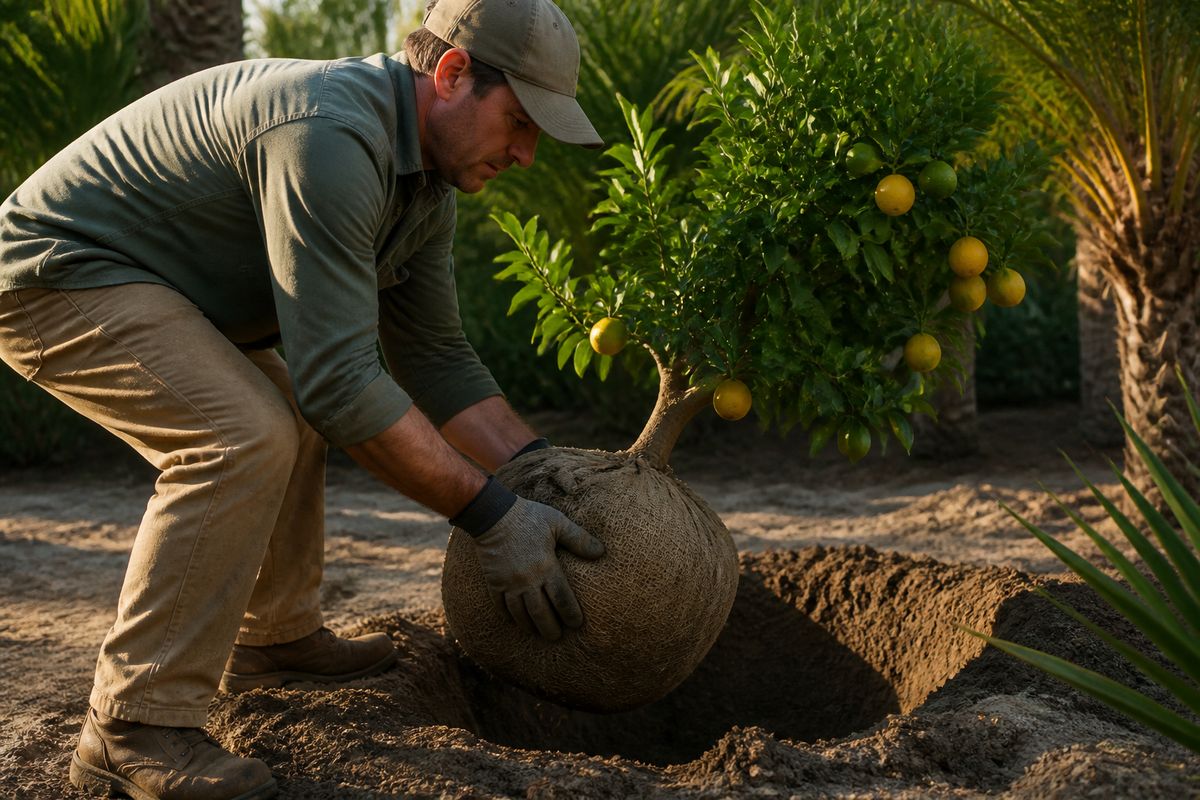
Use a sharp shovel so cuts are clean rather than torn, which speeds healing. As you undercut the ball, slide burlap or a tarp beneath it before you finish freeing it, and have one person steady the trunk while another works the shovel underneath. If the ball starts to crack apart, stop, re-support it, and adjust your lift point rather than forcing it. Never lift by the branches or trunk alone; the root ball's weight has to be carried from underneath.
Wrap, shade, and move the tree fast
Once the tree is out of the ground, wrap the root ball snugly in burlap to keep soil in place, get it into shade immediately, and get it to the new hole with as little delay as possible. Citrus shows leaf drop quickly once exposed roots start drying out in sun and wind. If planting has to wait more than a short while, mist the burlap lightly to keep it damp without soaking it, and keep the tree out of direct sun until it is back in the ground.
Replanting in the New Location
Match the original planting depth
Getting the depth wrong is one of the fastest ways to lose a transplanted citrus tree. Find the original soil line on the trunk before you set the tree, and match it exactly in the new hole. UF/IFAS's home citrus planting guidance is specific on this point: keep the top of the root ball level with the existing soil line rather than burying it deeper for stability.
- Dig the new hole slightly wider than the root ball, never deeper.
- Set the tree so the top of the root ball sits at the same height as the original ground line, using the soil-line mark on the trunk as your guide.
- Adjust soil under the ball before backfilling. Do not compact soil around the trunk to force a fit.
- Backfill gently with your fingers or a light tool to collapse air pockets, without stomping or hard-packing the soil.
Planted too deep, the trunk collar stays wet and rot-prone. Planted too high, the exposed root ball dries out fast, especially in Florida's sandy soils.
Improve drainage without creating a water trap
Citrus wants well-drained soil, so test before you commit to the spot: dig a hole roughly the size of the root ball and fill it with water to see how fast it drains. If water stands for more than a few hours, work in coarse compost with the native soil rather than heavy organic amendments that can create a soggy layer under the root ball. Shaping the planting area with a slight slope helps excess water move away instead of pooling at the trunk. In heavy clay or a naturally low spot, a raised planting mound is often a better fix than trying to amend your way out of poor drainage.
Stake only if the tree actually needs it
After setting the tree, gently nudge the trunk to test stability. If it leans noticeably or the site catches strong wind, stake it with soft, padded ties, never tight straps that can cut into bark as the trunk grows. Loosen or remove stakes once the tree has rooted in, usually by the end of the first growing season. If the root ball sits solidly and the trunk does not rock, skip staking altogether; unnecessary staking can weaken trunk taper over time.
Special Cases: Pots, Large Trees, and Mature Citrus
Moving potted citrus with minimal root disturbance
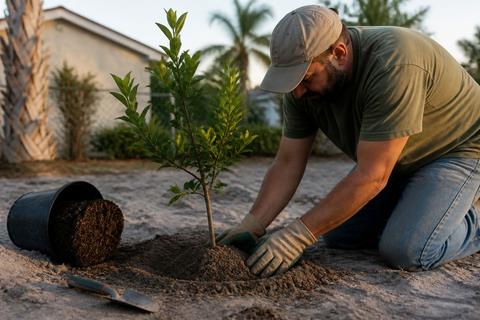
A potted tree already has a defined root ball, so the job is mostly about disturbing it as little as possible. Water the pot the day before the move, then turn it on its side and slide the tree out rather than yanking on the trunk or branches. If you see roots circling the outside of the root ball, loosen just that outer ring with your fingers instead of tearing into the whole mass. Plant at the same depth it grew in the pot, water thoroughly, and keep mulch a few inches back from the trunk flare once it is in the ground.
Handling large trees safely
A large citrus tree is heavy enough that a rough lift can tear out roots or hurt someone. Bring at least two extra hands, use a dolly or straps for anything you cannot carry safely, and dig the new hole wide enough that the tree can be set without twisting the root ball into place. If you cannot keep the root ball intact, or the tree is too big to move quickly, a professional with a tree spade is the safer and often cheaper option once you count the risk of losing a mature tree.
When a mature tree is better left alone
Success shrinks fast as a citrus tree ages, because moving it means losing a larger share of the root system relative to the canopy it has to support. If a tree is already thriving where it stands, improving the site with mulch, drainage correction, and light pruning is often a better investment than uprooting it. Save a full transplant for trees that are young enough, or struggling badly enough where they are, that the move is clearly worth the risk.
Aftercare for the First Year
Water on a steady schedule without overwatering
A freshly transplanted citrus tree needs consistent moisture while it regrows roots, and the common mistake runs in both directions: either letting it dry out between waterings or keeping the soil saturated. UF/IFAS's home citrus establishment guidance calls for watering roughly two to three times a week for about the first month, enough to wet the top few inches of soil around the root zone each time, then easing off as the tree shows new growth. In Florida's fast-draining sandy soils, lean toward the more frequent end of that range, especially through a hot, dry stretch. Hold off on fertilizer entirely until you see a flush of new growth, then use a citrus-specific fertilizer at the labeled rate rather than guessing at a dose.
Mulch correctly and keep it off the trunk
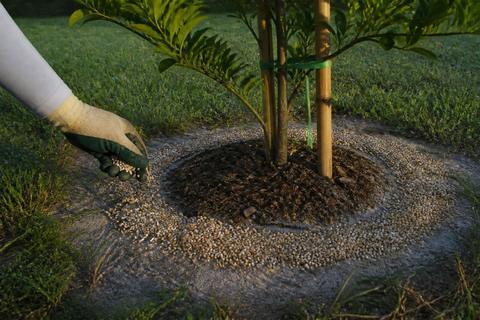
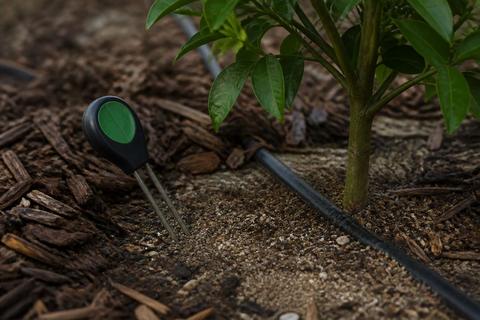
Mulch buffers soil temperature and moisture swings, but only if it is placed right. Spread a 3 to 4 inch layer over the root zone, and leave a clear gap around the trunk so mulch never touches the bark; piled-up mulch against the trunk invites collar rot. Shredded bark, wood chips, or pine bark fines all breathe well. Check after heavy rain, since mulch can wash or creep inward toward the trunk over time.
Watch for leaf drop, sunburn, and stalled recovery
Some leaf drop right after a transplant is a normal stress response, but track how the tree recovers over the following weeks. No new growth flush after three to four weeks is a sign of deeper stress, not just an adjustment period. Watch for sunburned bark or leaf scorch, especially on a tree that was used to some shade before the move, and shade it temporarily during harsh afternoon sun if needed, removing the shade gradually as it recovers. Check weekly for pests along the trunk and under leaves. Recovery that keeps stalling usually traces back to one of three things: too dry, too wet, or planted at the wrong depth.
Common Mistakes to Avoid
Transplanting at the wrong time of year
Timing drives recovery more than almost anything else on this list. Do not transplant citrus during extreme summer heat spikes when roots cannot keep the canopy supplied with water, and do not move a tree right before a cold snap in freeze-prone parts of Florida or Texas, especially a young tree with a freshly disturbed root system. Skip transplanting during drought even if you plan to irrigate heavily afterward; the tree is already running on thin reserves. If you miss your window, waiting for the next one beats forcing a move under stressful weather.
Planting too deep or in poorly drained soil
Depth and drainage are the two fastest ways to lose a citrus tree after an otherwise careful move. Keep the root ball at the original soil line. Too deep raises the risk of trunk and collar rot; too high dries out the exposed roots. Avoid low spots where water pools, since citrus roots do not tolerate prolonged saturation, and test drainage with the hole-and-water method before you commit to a planting site.
Overpruning or skipping aftercare
Do not prune heavily going into the move; remove only dead, damaged, or clearly excessive growth. Do not fertilize right after transplanting, since it can add stress while roots are trying to recover. Do keep to a steady watering schedule for the first month, then taper as the tree establishes, and do mulch correctly, kept off the trunk and over the root zone. Skipping these basics is the most common reason a transplanted tree sulks with leaf drop for months instead of bouncing back in weeks.
Frequently Asked Questions
When is the best time to transplant a citrus tree in Florida or Texas?
In Florida, UF/IFAS points to summer through early fall as the better window, once frost risk is gone and rainfall is steady. In Texas, AgriLife Extension advises waiting until the threat of frost has passed, typically March or April, later than the December-through-February dormant window recommended for most other fruit trees. Avoid moving citrus during extreme heat or active drought either way.
Can you transplant a mature citrus tree successfully?
Yes, but the odds get worse as the tree ages, since an older tree loses a larger share of its root system relative to its canopy when moved. Larger, older citrus often needs professional equipment and extra aftercare; a tree already thriving where it stands is sometimes a better long-term bet than uprooting it.
How do you transplant a potted citrus tree into the ground?
Pick a well-drained site, loosen only circling outer roots rather than tearing into the whole root ball, plant at the same depth it grew in the pot, and water thoroughly right after planting.
How much should you prune before moving a citrus tree?
Remove only dead, damaged, or clearly excessive growth. Heavy pruning before a move adds stress rather than helping, since it pushes the tree to support new leaf growth with a root system that already took a hit.
What is the biggest reason transplanted citrus trees die?
Root loss combined with the wrong planting depth or inconsistent watering afterward. Trees recover best when enough of the root system survives the move, the new site drains well, and watering stays steady without swinging between soaked and bone dry.