Tips for Growing Persimmons in Texas
Growing persimmons in Texas is one of the more forgiving fruit-tree projects you can take on, but the state's range of climates means the right variety and the right rootstock matter more than most guides let on. Persimmons cover Zones 7 through 10, and the same tree that fruits reliably in Tyler can sulk in Amarillo or rot at the roots in blackland clay near Austin.
American vs. Japanese Persimmons: Pick Based on Your Region
Texas gardeners have two real options. American persimmon (Diospyros virginiana) is native to East Texas, tough, and cold-hardy well into North Texas, but the fruit is small and most named selections still need a pollinator tree nearby to set a full crop. Japanese or "Oriental" persimmon (Diospyros kaki) is the one sold at nurseries and produces the large, market-style fruit, and it's what most of this guide covers.
One detail that trips up first-time growers in Central Texas: Oriental persimmon is grafted onto American persimmon rootstock because it is highly susceptible to root rot in the state's heavier, poorly drained clay soils, so if you're buying container stock, ask what rootstock it's on before you plant in anything but sandy loam.
Varieties That Actually Fruit Here
Persimmons have an unusually low chilling requirement, needing on the order of 100 hours or fewer below 45°F to break dormancy, which is why they perform well from the Panhandle down to the Gulf Coast and don't have the chill-hour problems that sink some peach and apple varieties in South Texas.
- Fuyu: non-astringent, can be eaten firm like an apple, self-fruitful, the standard pick for most home landscapes and the easiest to recommend to a first-time grower.
- Eureka: astringent, flat-shaped, small tree, heavy and reliable producer; needs to soften fully before eating.
- Tamopan: astringent, very large fruit with a distinctive ring constriction, the most vigorous and upright tree of the common varieties.
- Tane-nashi (Tanenashi) and Hachiya: astringent, widely planted, good flavor once fully ripe and jelly-soft.
These varieties are recommended for Texas plantings, and trees should be spaced 15 to 20 feet apart. Even with self-fruitful varieties like Fuyu, extension guidance suggests planting at least two trees for a fuller crop.
Astringent means exactly that: eat one before it's fully soft and it will pucker your mouth from the tannins. Fuyu and other non-astringent types are the ones you can eat while still firm.
Site Selection and Soil
Persimmons tolerate a wide range of soils but do best in a deep, fertile, well-drained loam. In Central Texas, avoid low spots and heavy, poorly drained clay if you can, since that's where Oriental varieties are most likely to develop root rot; a raised planting mound helps if drainage is your only option. Aim for slightly acidic to neutral soil, roughly pH 6.0 to 7.0, and give the tree full sun.
Planting
Plant bare-root trees in winter while they're dormant, and set out containerized stock in early spring once the worst freeze risk has passed. Dig the hole only as deep as the root ball and about twice as wide, backfill with the native soil rather than heavily amended mix (over-amending the hole can cause roots to circle instead of spreading into native soil), water in well, and mulch 2 to 3 inches deep, kept back from the trunk. Space trees 15 to 20 feet apart; mature Oriental persimmons can reach 40 feet, though most stay more manageable in the 10 to 20 foot range with pruning.
Watering and Fertilizing
Persimmons need roughly 36 to 48 inches of water a year, which in most of Texas means supplemental irrigation on top of rainfall, especially during spring growth flush and through summer heat. Established trees handle short dry spells better than most fruit trees, but fruit drop increases if the tree goes from bone-dry to a heavy soaking, so keep watering consistent once fruit is sizing rather than swinging between extremes.
Go light on fertilizer. A balanced, slow-release feed in early spring is enough for most trees; heavy nitrogen pushes leafy growth at the expense of fruit and can worsen fruit drop.
Pruning
Prune while dormant in late winter. Select 3 to 5 main scaffold limbs on young trees, remove root suckers and crossing branches, and thin crowded interior growth so light reaches the fruiting wood. Persimmons fruit on new growth from the current season, so hard annual pruning isn't necessary once the tree has its shape, light, structural thinning is usually all a mature tree needs.
Pests and Diseases
This is where persimmons genuinely outperform peaches and other Texas fruit trees: they're virtually pest-free, with occasional twig girdler damage or a leaf spot fungus, neither of which typically needs spraying. Wildlife is a bigger nuisance than insects in practice, deer and squirrels will eat fruit before it ripens if given the chance, so fencing or netting young trees is often more useful than any spray program. The real disease risk in Texas is root rot in wet, heavy soil, which is another reason drainage matters more than a pest-spray schedule.
Fruit Drop and Why It Happens
Young or stressed persimmon trees commonly drop a portion of their immature fruit in early summer. Inconsistent watering, a late cold snap during bloom, or a tree still establishing its root system are the usual causes. It's normal enough that it shouldn't be read as a sign of disease; consistent watering and patience with young trees reduce it over time.
Harvest
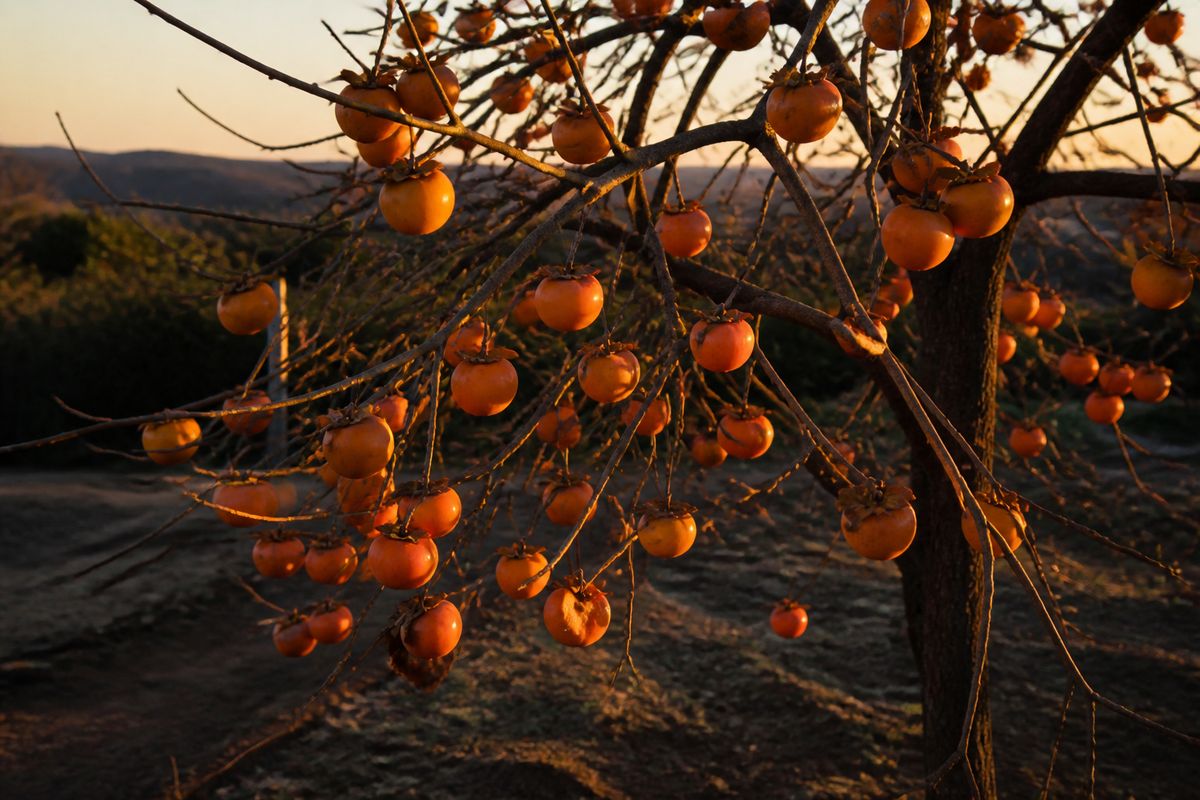
Persimmons are one of the last fruits to ripen in Texas, typically mid-to-late fall into early winter, and fruit will often hang on the bare branches after the leaves have dropped. Pick non-astringent types like Fuyu when firm and colored. For astringent varieties, wait until the fruit is fully soft, almost jelly-like, or it will taste chalky and bitter. Fruit continues to soften and sweeten off the tree at room temperature; refrigerate ripe fruit to extend it another one to two weeks.
FAQ
How long until a persimmon tree fruits in Texas?
Most grafted trees begin bearing within 3 to 5 years of planting. Seedling or own-root trees can take longer.
Do I need two trees to get fruit?
Fuyu and some other Japanese varieties are self-fruitful, but extension guidance still recommends planting at least two trees for a fuller crop. American persimmon is more likely to need a pollinator for a full crop, so plant more than one if you're growing the native type.
Why is my persimmon tree dropping fruit before it ripens?
Some early drop is normal, especially in young trees, and is usually tied to uneven watering or the tree still establishing itself rather than disease.
Can persimmons handle a Texas winter?
Established, dormant Japanese persimmon trees tolerate temperatures down to around 0°F, which covers USDA Zones 7 and up, most of the state outside the coldest Panhandle pockets. A warm spell that breaks dormancy early followed by a hard freeze is the bigger risk than a typical cold winter.