Tips for Growing Elderberries in Texas
Tips for growing elderberries in Texas start with picking the right species: American elderberry (Sambucus canadensis), not the European kind sold at big-box nurseries. Texas summers routinely hit the upper 90s and the state spans USDA zones roughly 6b in the Panhandle to 9b along the coast, so the variety and the site you choose matter more here than almost anywhere else elderberries are grown.
Pick American elderberry, not European
Sambucus canadensis is native to the eastern half of the U.S., including Texas, and it's the one that shrugs off heat and humidity. Sambucus nigra, the European species used in a lot of commercial syrup, wants cooler summers and tends to scorch and stall out once daytime highs stay above 95°F for weeks at a time. If a nursery tag just says "elderberry" without a species, ask, or check for a cultivar name.
Named cultivars bred from wild American elderberry are your best bet:
- Bob Gordon: released by the University of Missouri from a wild Ozark plant; blooms later than most cultivars, which helps it dodge late frosts, and produces heavy, uniform clusters.
- Wyldewood: an Ozark-region selection often planted as a cross-pollinator for Bob Gordon.
- Adams and York: older, widely available cultivars that tolerate heat reasonably well, though yields are usually lower than Bob Gordon's.
Plant at least two different cultivars. Elderberries are far more productive with a cross-pollinator nearby, and a single lone bush will flower but often sets little fruit.
Zones, heat, and where elderberries actually work in Texas
American elderberry is rated for USDA zones roughly 4a through 8b, according to NC State Extension's plant database. That covers North Texas, the Panhandle, Central Texas, and the Hill Country without much fuss. In zone 9a/9b areas of South Texas and the Rio Grande Valley, the plant will usually survive but pushes the edge of its comfort zone during the longest, hottest summers, so give it afternoon shade there rather than a full-sun spot with reflected heat off a wall or driveway.
Chill hours are less of an issue for elderberry than for peaches or apples; it isn't a fussy chill-hour crop, and it breaks dormancy readily across Texas' mild winters. The bigger risk is late-spring cold snaps hitting early flowers, which is why later-blooming cultivars like Bob Gordon are worth seeking out.
Site, soil, and water
- Sun: Full sun in North and Central Texas; afternoon shade in South Texas and along the Gulf Coast once summer highs push past 95°F for extended stretches.
- Soil: Elderberries tolerate clay, loam, and sandy soils and aren't picky about pH, but they do best in soil with decent organic matter that holds some moisture. If you're planting into heavy Blackland Prairie clay, work in 2-3 inches of compost across the planting area rather than just backfilling the hole with it.
- Water: These are moisture-loving shrubs for a moisture-scarce state. Plan on deep watering once or twice a week through the first two summers while roots establish, then taper to supplemental watering during multi-week dry spells. Mulch 2-3 inches deep to cut evaporation; skip irrigation entirely in a Texas summer and you'll likely see leaf scorch and dropped fruit.
Planting timing and spacing
Plant bare-root or container elderberries in late winter, from roughly January through early March, while plants are still dormant or just breaking bud. This gives roots a few months to establish before the first 100°F stretch hits. Fall planting (October-November) also works in most of the state and lets roots settle over a mild winter.
Space plants 6 to 8 feet apart. Mature bushes commonly reach 6 to 12 feet tall and spread just as wide, and they sucker outward over time, so give them room or plan on cutting back the spread each year.
Pruning
Elderberries fruit on second-year and older wood as well as some current-season growth, so hard annual pruning isn't required the way it is for blackberries. In late winter, before bud break:
- Remove any canes older than 3 years: they'll be woodier, grayer, and less productive.
- Cut out dead, damaged, or crossing stems to keep airflow through the center of the plant.
- Leave the youngest, thickest canes; these carry the bulk of next season's fruit.
Skip pruning entirely the first year after planting so the shrub can build root and cane mass.
Pests and disease pressure in Texas
Elderberry is genuinely low-maintenance on the pest front compared to most fruiting shrubs. Watch for aphids on new growth (a strong hose spray usually knocks them back) and occasional borer damage in stressed canes. Cane borers are more likely to move into a plant that's already stressed by drought, so consistent watering is itself a pest control measure. Powdery mildew can show up in humid East Texas summers; thinning canes for airflow is the main defense, since fungicide isn't usually necessary on an otherwise healthy plant.
The bigger threat in Texas is often birds and heat, not insects. Netting ripening clusters is common if mockingbirds and grackles are working the patch.
Harvest
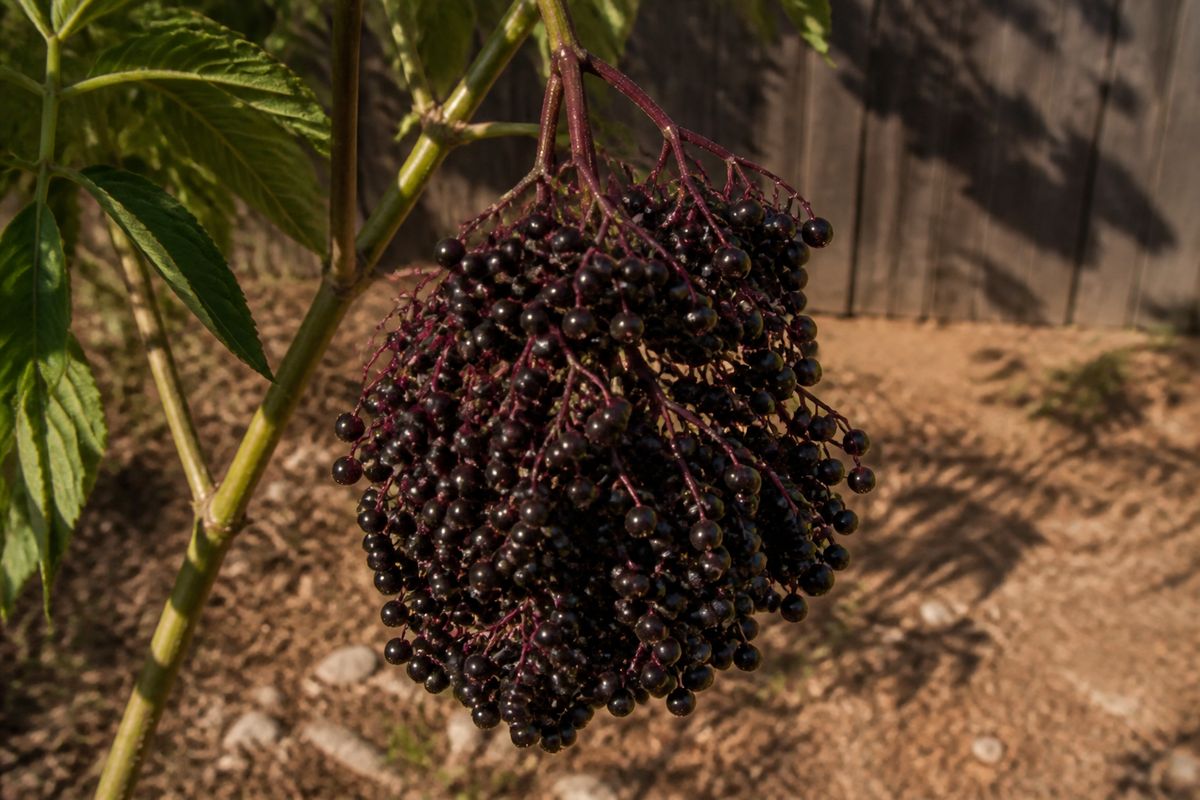
Depending on cultivar and region, elderberries bloom in late spring and ripen from mid-to-late summer into September. Berries are ready when the whole cluster turns uniformly dark purple-black and berries detach with a light tug rather than resisting. Cut the entire flower head (cyme) rather than picking individual berries, then strip berries off the stems once you're off the plant; a fork works well for this.
Do not eat raw elderberries, stems, leaves, or bark. Raw and unripe elderberry contains compounds that can cause nausea and, in some cases, more serious illness. Cooking fully ripe berries deactivates these compounds and is what makes syrups, jams, and jellies safe, according to Oregon State University Extension's guidance on preserving elderberries. Strip berries from stems before cooking, since stems concentrate more of the toxic compounds than the fruit does.
Honest difficulty rating for Texas gardeners
What elderberry does well here: tolerates heat better than most fruiting shrubs, isn't picky about soil pH, shrugs off Texas' mild winters, and needs comparatively little pest management once established.
What it does not do well: survive true neglect during a Texas drought (it will drop leaves and fruit without supplemental water), or produce well from a single unpollinated bush. It also isn't a fast producer: expect a light first harvest in year two and a meaningful crop by year three or four.
Overall, elderberry is a moderate-effort, high-payoff choice for Central, North, and East Texas gardeners with irrigation, and a doable-but-more-demanding one for South Texas and the Valley, where afternoon shade and extra water are worth the trouble.
FAQ
Do elderberries need a pollinator plant?
Not strictly, since many cultivars are self-fertile, but planting two different cultivars together dramatically improves fruit set. Pair Bob Gordon with Wyldewood, or plant any two named cultivars rather than one.
Can elderberries handle a Texas summer without irrigation?
Established plants (3+ years) tolerate short dry spells, but expect scorched leaf edges and reduced fruiting without at least occasional deep watering during July and August. Newly planted bushes need regular water through their first two summers.
How long until an elderberry bush produces fruit?
Most cultivars give a small harvest in their second year and reach full production by year three or four, depending on growing conditions and how well the plant establishes.