Tips for Growing Blackberries in Texas
Growing blackberries in Texas is one of the more forgiving fruit projects a home gardener can take on. The plants tolerate our brutal summer heat, need less winter chill than peaches or apples, and the varieties actually developed here in Texas can keep producing for 20 years or more, though Arkansas-bred varieties like Kiowa typically run 5 to 10 years. Pick a variety suited to your part of the state and you'll do fine. Most of the trouble growers run into comes down to two mistakes: planting a variety bred for a cooler climate, or skipping the pruning that keeps disease pressure down. Here is what actually works.
Why Blackberries Do Well Here
Blackberries can be grown across USDA Hardiness Zones 7, 8, and 9, which covers essentially all of Texas, according to Texas A&M AgriLife Extension's blackberry production guide. They need relatively few winter chilling hours to set fruit, and mature, healthy plants can yield 5 to 10 pounds of fruit per plant. The catch is that not every blackberry variety on the shelf at a nursery was bred for this climate, and picking the wrong one is the single biggest reason home plantings disappoint.
Choosing a Variety That Actually Fruits in Texas
Chill hours (the number of hours below 45°F a plant needs over winter to break dormancy properly) is the number that matters most for Texas growers, along with your region's summer heat tolerance. AgriLife's variety table lists specific chill requirements, so match the variety to where you actually live rather than to what looks good in a catalog photo:
- Kiowa (thorny) – needs only 200 chill hours, bears the largest fruit of any variety recommended for Texas, and is the top-performing thorny Arkansas-bred cultivar for Texas conditions.
- Rosborough (thorny) – a Texas A&M release from 1977, considered the best early variety for East and South Central Texas, sweeter than Brazos.
- Brazos (thorny) – the old standby, developed at Texas A&M in 1950, usually the first to ripen in the state, very drought and heat tolerant, though the fruit is tart enough that it's better for cooking than eating fresh.
- Ouachita (thornless) – needs 300 chill hours, matures mid to late season with heavy yields of firm berries.
- Arapaho (thornless) – needs about 500 chill hours, resistant to double blossom and orange rust, best suited to Zone 8 and warmer.
- Navaho (thornless) – needs 800 chill hours and should not be planted in Central or South Texas; save it for the northern part of the state.
Notice the pattern: the varieties bred at Texas A&M (Brazos, Rosborough, Womack, Brison) and the low-chill Arkansas variety Kiowa tend to be the most reliable statewide. Higher-chill thornless varieties like Navaho and Apache (800 hours) can still struggle or underperform south of I-20. If you want fruit over a longer window, AgriLife's own recommendation is to plant more than one type, since thorny, thornless, and primocane-bearing varieties ripen at different times.
Site Selection and Soil
Give blackberries full sun and well-drained soil at least a foot deep. Texas A&M AgriLife lists an acceptable pH range of 4.5 to 7.5; above 8.0, plants start showing iron chlorosis (yellowing between the leaf veins) and need chelated iron applied to the soil or foliage to correct it. If you're on heavy clay or a site that holds water, plant on raised beds or berms so the crown doesn't sit in standing water.
Steps before you plant:
- Get a soil test. It's the only way to know your actual pH and whether you're dealing with an iron chlorosis risk before you've committed a row to plants.
- Kill perennial weeds the year before planting, especially wild dewberries growing nearby – they carry the same diseases as cultivated blackberries and are nearly impossible to remove once your plants are established next to them.
- Work in compost or aged manure if your soil is thin or compacted.
- Build raised rows if drainage is a question mark. It's cheap insurance against root rot.
Planting
Dormant bareroot plants and rooted cuttings go in the ground in mid to late winter. Container-grown nursery plants are more flexible and can be planted in fall, winter, or spring as long as you keep them watered while they establish. Space plants 2 to 3 feet apart within the row, with rows 8 to 12 feet apart, enough room for a trellis, airflow, and a mower or cart down the middle.
Set the crown at or just above soil level rather than burying it deep, water it in well, and mulch with hay, chipped limbs, pine straw, or bark. One thing to skip: don't use pruned blackberry canes as mulch in Texas, since they can reintroduce disease into the planting.
Watering and Fertilizing
Start irrigating in March or April and water carefully through bloom and fruit sizing, when the plant is most sensitive to drought stress. Keep watering through harvest, then taper off by September so the canes can harden off before winter. Drip line laid along the row and covered with mulch works better than overhead sprinklers, which keep foliage wet and invite fungal disease.
Nitrogen is the nutrient that matters most here. Apply it in two split doses: once in spring as buds break dormancy, and again in summer right after harvest wraps up. Get your soil tested every three years so you catch pH drift or iron chlorosis before it shows up as yellow leaves.
Pruning: Primocanes and Floricanes
This is the step most home gardeners skip, and it's the one that determines whether you get a good crop next year. Blackberries are biennial: primocanes are the new green canes that grow this season, and floricanes are last year's canes, the ones that flower and fruit before dying.
- During the growing season, tip-prune primocanes (pinch or cut a few inches off the growing tip) once they reach the top of your trellis. This forces lateral branching, which means more fruiting sites next year.
- As soon as a floricane finishes fruiting, cut it out at the base. It will never fruit again and is now just a disease liability sitting in your row.
- Remove and destroy dead or diseased canes as early in the season as you spot them, not at the end.
A simple two-wire trellis, with wires at 30 and 60 inches, keeps heavy-fruited canes off the ground and makes both pruning and picking easier. Texas A&M's guide also notes that in plantings badly infested with double blossom or similar disease, mowing all canes to the ground in midsummer is a legitimate (if drastic) reset – it costs you a year of floricane fruit but knocks back disease pressure hard.
Pests and Diseases You'll Actually See
Blackberries aren't trouble-free in Texas. The two fungal diseases that cause the most damage are:
- Double blossom (rosette): the most serious fungal disease in East and Southeast Texas. Infected canes send up broom-like, misshapen blooms that never set usable fruit. Brazos, Womack, and Kiowa have some tolerance; many thorny varieties don't. Remove and destroy infected canes, and if it's bad enough, mow the whole planting to the ground.
- Orange rust: shows up as masses of orange spores on leaves in spring. Once a cane is infected, it and everything that grows from it afterward is permanently nonproductive – there's no curing an infected cane, only removing it. It hits thornless varieties especially hard.
Insect pressure comes mainly from leaf-footed plant bugs, stink bugs, spider mites, red-necked cane borers, and thrips. Wide spacing, a clean trellis, and yearly removal of dead canes do more to keep all of this in check than spraying does – good airflow through the row lets foliage dry out and starves the fungal problems before they start.
Harvest
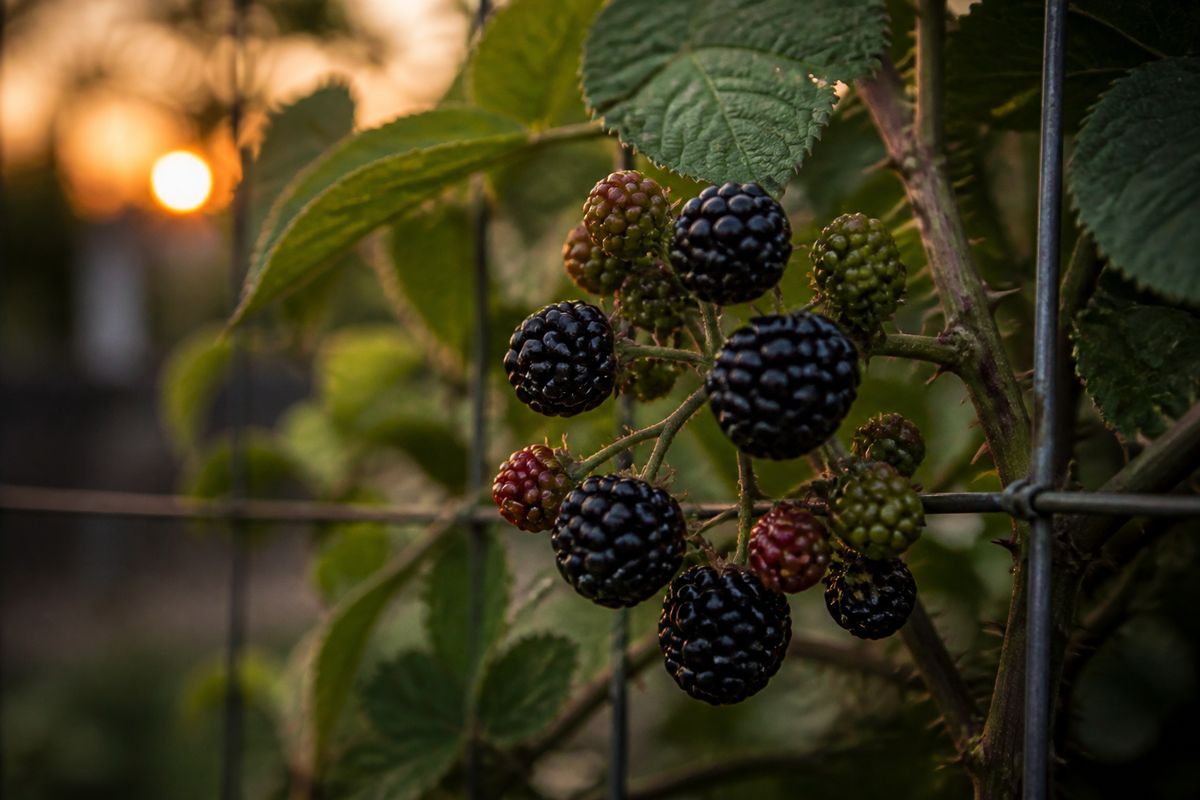
Blackberries don't ripen after picking, so timing matters. Wait until the fruit has gone from red to glossy black to a duller, fully black color before you pick – that dull-black stage is when the flavor peaks. Small plantings should be picked three to four times a week during the season since ripe fruit that's left on the cane will start to decline within days. Refrigerate promptly; blackberries soften fast once picked and won't hold at room temperature for more than a few hours.
Frequently Asked Questions
What part of Texas is best for growing blackberries?
Nearly the whole state works, since Texas spans USDA Zones 6b through 9b and blackberries are adapted to Zones 7 through 9. East and South Central Texas have historically been the strongest regions for the Texas A&M-bred varieties like Rosborough and Brazos. Far South Texas and the northern Panhandle are the two edges where variety choice matters most: go low-chill in the south, and save the high-chill thornless varieties like Navaho for the north.
Do I need two varieties to get fruit?
No, blackberries are self-fruitful, so a single plant will set fruit on its own. Planting more than one variety is worth doing anyway if you want a longer harvest window, since thorny, thornless, and primocane-bearing types ripen at different points in the season.
Why didn't my blackberries fruit well the first year?
That's normal for floricane-bearing varieties, which make up most of the Texas-recommended list. They fruit on year-old canes, so a newly planted floricane variety puts its first-year energy into primocane growth and doesn't produce a real crop until year two.
Are thornless varieties worth it?
They're easier to prune and pick, but thorny varieties are generally more productive with larger fruit, and every variety actually developed in Texas (Brazos, Rosborough, Womack, Brison) has thorns. Thornless varieties like Ouachita and Arapaho are solid choices, but don't assume thornless automatically means better yields.